Imprint MIS: building a fast, AI-visible website for a 45-year-old software company
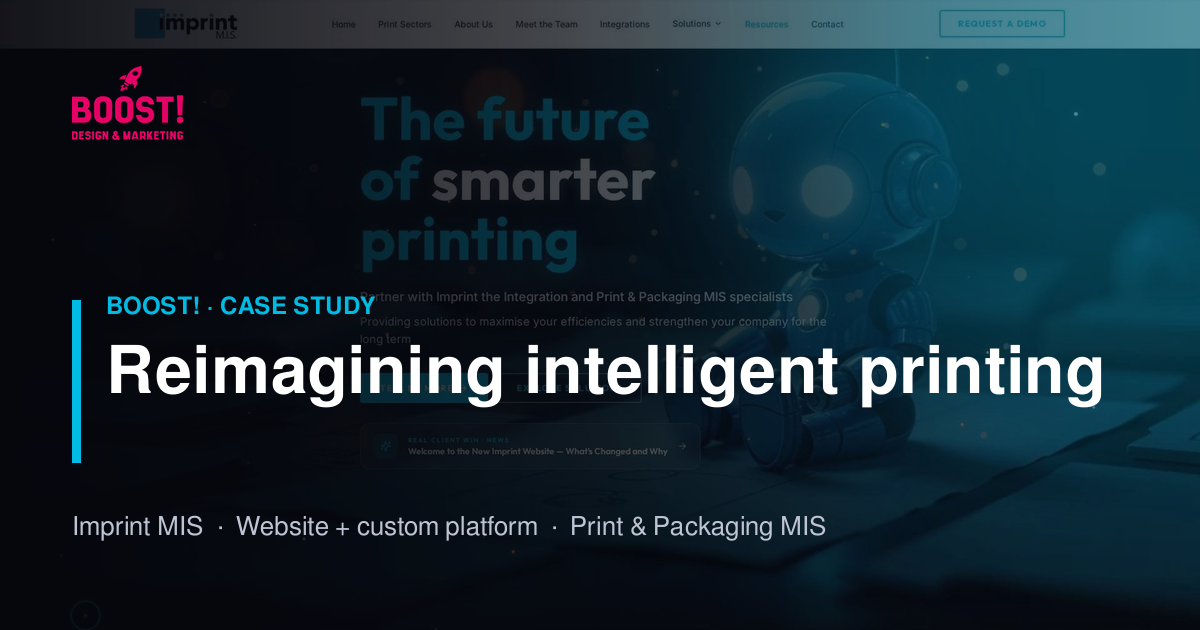
287KB of JavaScript, 43KB hero images, 12+ structured-data schemas and 16 AI crawlers welcomed by name. How we rebuilt the public site and admin platform for a print MIS specialist — and the performance playbook behind it.
Imprint MIS has been in business since 1979. It builds management information systems for the print industry — JDF and CIP4 workflow specialists, members of the IPIA and Picon, with 24+ pre-built integrations. Deep expertise, long relationships, serious technical credibility.
None of which was obvious from the old website.
That's the classic B2B problem: the knowledge lives in the team, not on the page. And in 2026 the page has two audiences — the buyer, and the AI assistant the buyer asks first.
The brief: look as modern as the software
Three things had to be true of the new site:
- Fast. Print-industry buyers often browse from office networks and factory-floor tablets. Weight is a tax on every visit.
- Credible. 45 years of expertise, shown not claimed.
- Citable. When someone asks an AI assistant "which print MIS supports JDF?", the answer should contain Imprint MIS.
Performance: the numbers we shipped
| Metric | Result |
|---|---|
| JavaScript shipped | 287KB gzipped — around 73% smaller over the wire |
| Largest hero image | 43KB WebP, from a ~1.2MB source library |
| Structured-data schemas | 12+, machine-readable top to bottom |
| AI crawlers explicitly welcomed | 16, by user-agent name |
How we got there — the same playbook we use on every build, including the one we'd build for you:
- Ship HTML first. Content exists in the markup, not assembled at runtime.
- Modern image formats, properly sized. WebP, responsive
srcset, explicit dimensions so nothing shifts as it loads. - No framework for the sake of it. Every dependency has to justify its kilobytes.
- System fonts and subset webfonts, preloaded, with sensible fallbacks.
- Lazy-load below the fold, never above it.
The custom admin platform
Alongside the public site we built a bespoke admin platform — the part visitors never see, and the part that saves the team hours. Content, integrations and structured data are all managed in one place, so the marketing story and the technical reality stay in sync.
This is the pattern we keep returning to: a fast public shop window plus a private system that removes manual work. You can see the same approach in our Temple of Sound and London Drumstick Co. builds.
GEO: being the answer, not just a result
Generative Engine Optimisation is the newer half of our work. Traditional SEO gets you into a list of ten blue links. GEO gets you quoted inside the answer.
What we implemented for Imprint MIS:
- 16 AI crawlers welcomed by name in
robots.txt— GPTBot, OAI-SearchBot, ClaudeBot, PerplexityBot, Google-Extended, CCBot, meta-externalagent and more. - An
llms.txtfile: a plain-text, no-JavaScript summary of what the company does, who it serves and where to find the detail. This is the single highest-leverage GEO file most sites are still missing. - 12+ structured-data schemas so machines can parse the entity, its products, its FAQs and its breadcrumbs without guessing.
- Answer-shaped content. Every important page answers a question a buyer would actually type or speak.
If you want the detail on how we apply this for local businesses as well as software companies, our SEO and GEO growth programmes spell out exactly what's included at each tier.
Why a Saffron Walden agency, for a national B2B brand?
Because proximity and reach aren't opposites. We're based on Fairycroft Road in Saffron Walden, 20 minutes from Cambridge, 25 from Bishop's Stortford — close enough to sit in a room with you, connected enough to serve clients nationally. For technical B2B companies in the Cambridge cluster especially, that combination of hands-on availability and city-grade technical SEO is hard to find.
Read the complete build, screen by screen, in the Imprint MIS case study.
The takeaway for any B2B website
- Audit your weight. If your site ships more than 500KB of JavaScript, you're paying for it in bounce rate.
- Write the knowledge down. The expertise in your team is your entire SEO moat.
- Add structured data. It's the difference between a machine understanding you and guessing.
- Publish an
llms.txt. Thirty minutes of work, and it's how AI assistants learn what you do. - Welcome AI crawlers deliberately. Blocking them by default is the quietest way to disappear.
What Cambridge-cluster companies get wrong about search
We see the same four mistakes in technical and B2B businesses around Cambridge, Saffron Walden and the wider Cambridgeshire–Essex corridor:
1. Writing for investors, not buyers. Homepages full of positioning language and nothing a customer would actually search for. If your product solves "print job costing", the words "print job costing" need to exist on the page.
2. Hiding everything behind a JavaScript app. Beautiful to use, invisible to most AI crawlers. If the content isn't in the HTML, it can't be quoted in an AI answer — and increasingly, the AI answer is the search result.
3. No local footprint at all. National and international B2B companies often skip local signals entirely, then wonder why they don't appear for "software company near Cambridge" or for local recruitment and partner searches. A complete Google Business Profile and a clear address cost nothing and help both rankings and credibility.
4. One page per product, zero pages per question. Buyers search in questions. Each real question you answer properly is another entry point — and another chance to be the cited source.
A technical SEO checklist for East of England businesses
Work top to bottom; the order is deliberate.
- Crawlability first. Can a text-only crawler read your main content? Disable JavaScript and look.
- One canonical URL per page, consistently linked internally.
- Core Web Vitals in the green on mobile, not just desktop.
- Structured data for Organization, Product or Service, FAQ and Breadcrumb at minimum.
- An
llms.txtsummarising what you do, who you serve and where to find detail. - Named AI crawlers allowed in
robots.txt, with a conscious decision rather than a default. - A local page per real service area — ours cover Saffron Walden, Cambridge, Bishop's Stortford, Haverhill and Great Dunmow.
- Internal links from your best content to your most commercial pages.
- A journal or insight hub that publishes answers, not announcements.
None of this is glamorous. All of it compounds. Imprint MIS went from a dated, slow, search-invisible site to one engineered to be found by both Google and the AI assistants that increasingly sit in front of it — and the same checklist applies whether you sell print MIS software nationally or fit kitchens in Great Dunmow.
Want results like these in your town?
BOOST! Design & Marketing is based at 27 Fairycroft Road, Saffron Walden, Essex — a short drive from Cambridge, Bishop's Stortford, Haverhill and Great Dunmow. We build websites, run Google and Meta Ads, and make brands visible in both Google and AI assistants like ChatGPT, Perplexity and Google AI Overviews.
- Marketing in Saffron Walden
- Marketing in Cambridge
- Marketing in Bishop's Stortford
- Marketing in Haverhill
- Marketing in Great Dunmow
See website design pricing, build a quote in two minutes, or email team@boostmarketing.agency · 07909 970556.
Frequently asked
What makes a B2B website 'AI visible'?
Clean server-rendered or crawlable HTML, explicit structured data (Organization, Product, FAQ, Breadcrumb), a plain-language llms.txt summary, and content written as answers to real questions. Most AI crawlers don't execute JavaScript, so anything hidden behind a script never gets cited.
Does site speed still affect rankings?
Yes — Core Web Vitals are a confirmed ranking signal, and more importantly a conversion signal. Cutting Imprint MIS's shipped JavaScript by roughly 73% over the wire improved both.
Do you build custom admin platforms as well as websites?
Yes. For Imprint MIS we built the public website plus a bespoke admin platform. We do the same for clients across Essex, Hertfordshire and Cambridgeshire when an off-the-shelf tool can't model their workflow.
How much does a website like this cost?
Our packages and bespoke build pricing are published openly on our website design pricing page, and you can assemble an instant quote online.
See the full case studyImagery, timeline and the technical detail behind this story.
View case study