From 2.8★ to 4.9★: how we rebuilt Diamondbrite's online reputation
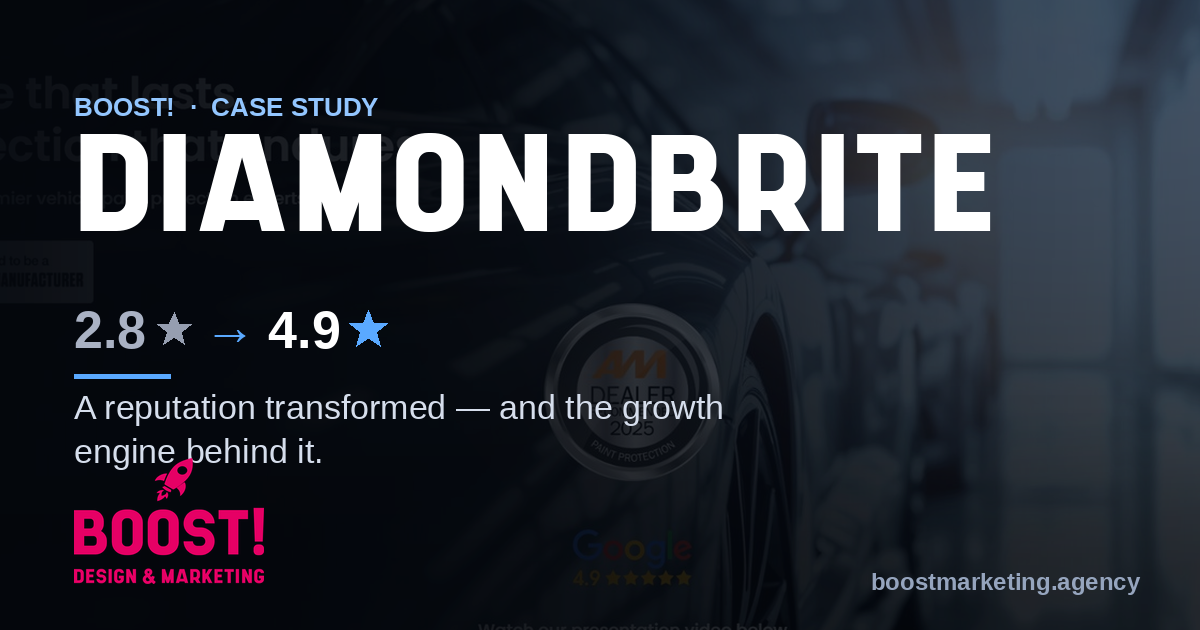
A 105x increase in Google reviews, a 4.9★ rating and thousands saved on photography. Here's the reputation and ecommerce system we built for one of the UK's best-known vehicle-care brands — and how any Essex or Cambridgeshire business can copy it.
Reputation is the quietest, most expensive thing a business can neglect. You can have the best product on the shelf and still lose the sale, because a new customer checks Google first — and Google was telling Diamondbrite's story badly.
When our partnership with Diamondbrite (part of Jewelultra Ltd, one of the UK's leading names in vehicle care and paint protection) began, the brand had four Google reviews averaging 2.8★. Today it sits at 4.9★ with 422+ reviews — a 105x increase in review volume and one of the strongest reputations in its industry.
Here's exactly how it happened, and what it means for any business in Saffron Walden, Cambridge or the wider East of England that's quietly losing customers to a weak Google profile.
The problem wasn't the product — it was the proof
Diamondbrite sells through dealerships and direct to drivers. Its paint protection is trusted by professionals, but the public-facing proof didn't match:
- Four reviews. Not enough for anyone to form a judgement.
- 2.8★. Low enough to actively deter a purchase.
- No reply strategy. Unanswered reviews read as an absent brand.
- Expensive photography cycles. Every new product and seasonal promo meant another shoot.
Low review counts create a vicious circle: fewer reviews means lower local visibility, which means less traffic, which means fewer reviews. The only way out is to make reviewing systematic instead of hopeful.
Step 1: Automated review invitations (the compounding engine)
We built an automated post-purchase flow. After every order, the customer receives a branded invitation to share their experience, with a thank-you discount on their next purchase as a genuine, unconditional gesture.
Three details did the heavy lifting:
- Timing. The invitation lands when the product has actually been used, not the moment the parcel ships.
- Friction. One tap to the review form. Every extra click halves completion.
- Reciprocity. A thank-you discount that rewards the customer whether the review is glowing or critical — which keeps it compliant and keeps the feedback honest.
Review generation isn't a campaign. It's a system that runs quietly in the background of every single order.
Step 2: Reply to every review, in the brand's voice
Every review gets a personalised reply. Not "Thanks for your feedback!" — an actual response that references what the customer said.
This matters for two reasons. Customers reading replies see a business that cares. And Google reads those replies as fresh, relevant text attached to the profile, which compounds local search visibility over time. If you only do one local SEO task this month, do this one.
Step 3: Ecommerce that converts the traffic you earn
A stronger reputation sends more people to your store, so the store has to be ready. For Diamondbrite we built and continue to optimise:
- A points and rewards loyalty scheme, turning first-time buyers into repeat customers.
- DHL fulfilment automation, removing manual admin from every order.
- A TreeNation sustainability partnership, giving the brand a genuine environmental story.
- An AI chatbot that handles repeat product questions and saves hours of office time every week.
- A dynamic store with seasonal promotions and real-time updates.
Step 4: Replace photography with 3D renders
This one saved thousands. Instead of booking a studio shoot for every product and promotion, we produce photo-realistic 3D renders: consistent lighting, infinite angles, no reshoots when packaging changes. Add chrome-effect Graphene labels, event and POS design, and training certificates, and the brand looks the same whether you meet it in a dealership, at a trade show or on a phone screen.
The results
| Metric | Before | Now |
|---|---|---|
| Google rating | 2.8★ | 4.9★ |
| Review volume | 4 | 422+ |
| Review replies | None | Every single one |
| Product photography | Repeat studio shoots | 3D renders — £1,000s saved |
| Office time on FAQs | Manual | Hours saved weekly via AI chatbot |
Read the full story, with imagery and timeline, in the Diamondbrite case study.
How to copy this if you're a local business
You don't need Diamondbrite's scale. The same five moves work for an independent garage in Great Dunmow, a dental practice in Bishop's Stortford, or a B2B firm in Cambridge:
- Claim and complete your Google Business Profile. Correct category, real photos, accurate NAP (name, address, phone) matching your website exactly.
- Automate the ask. Build review invitations into your existing order, invoice or job-completion emails.
- Reply to everything within 48 hours, including the awkward ones.
- Point reviews at the right page. Reviews plus a strong local landing page is what wins the local pack.
- Measure monthly. Rating, volume, recency and the keywords customers use about you.
For businesses across Essex, Hertfordshire, Suffolk and Cambridgeshire, local reputation is still the cheapest competitive advantage available — and now it feeds AI answers too. When someone asks ChatGPT or Google AI Overviews for "the best paint protection brand in the UK", the model leans on the same signals: reviews, consistency and clear, crawlable content. That's the overlap between traditional SEO and GEO (Generative Engine Optimisation), and it's where we spend most of our time.
Local reputation, town by town
Reputation isn't one national number — it's a different fight in every town, because you're competing against a different set of names in each local pack.
Saffron Walden. A small, high-trust market town where word of mouth still moves faster than advertising. The businesses winning here have a complete Google Business Profile, recent reviews that mention the town by name, and a local landing page that actually says where they are. If you're a trades business, salon, garage or professional practice on or around the High Street, review recency matters more than total volume.
Cambridge. The most competitive local market we work in. Review volume alone won't carry you — you need reviews plus authoritative content plus technical health. Our Cambridge marketing page sets out how we approach a city packed with start-ups, scale-ups and established names all bidding for the same terms.
Bishop's Stortford. A commuter town with high search intent and a lot of cross-border competition from Hertfordshire and Essex at once. Clear service pages and local reviews beat generic county-wide messaging every time — see marketing in Bishop's Stortford.
Haverhill and Great Dunmow. Smaller catchments where a handful of good reviews can genuinely change the local pack order within a quarter. If you serve surrounding villages, name them on the page — that's how "near me" searches resolve. More on Haverhill and Great Dunmow.
The 90-day local reputation plan
If you want to run the Diamondbrite playbook at local scale, this is the order we'd do it in:
Days 1–14 — fix the foundations. Claim and complete the Google Business Profile. Match your name, address and phone number exactly across the website, Companies House, Facebook, LinkedIn and every directory you've ever been listed in. Inconsistent NAP data is the most common reason good local businesses rank below worse ones.
Days 15–30 — build the ask. Add a review request to your existing job-completion, invoice or dispatch email. One link, one sentence, no PDF attachments. Train whoever speaks to customers to mention it in person; a verbal prompt followed by an email roughly doubles response rates.
Days 31–60 — reply and publish. Reply to every review, old ones included. Publish two pages that answer the questions you get asked on the phone most often. Add FAQ structured data so Google and AI assistants can lift the answers directly.
Days 61–90 — measure and compound. Track rating, review count, reviews-per-month and which search terms customers use about you. Then keep going: the compounding only works if the system keeps running after the initial push.
That's it. No clever hacks, no paid review schemes — just a system that turns satisfied customers into visible proof, month after month. It worked for a national vehicle-care brand, and it works for a two-person business in a market town.
Want results like these in your town?
BOOST! Design & Marketing is based at 27 Fairycroft Road, Saffron Walden, Essex — a short drive from Cambridge, Bishop's Stortford, Haverhill and Great Dunmow. We build websites, run Google and Meta Ads, and make brands visible in both Google and AI assistants like ChatGPT, Perplexity and Google AI Overviews.
- Marketing in Saffron Walden
- Marketing in Cambridge
- Marketing in Bishop's Stortford
- Marketing in Haverhill
- Marketing in Great Dunmow
See website design pricing, build a quote in two minutes, or email team@boostmarketing.agency · 07909 970556.
Frequently asked
How long does it take to improve a Google rating?
With a steady flow of genuine review invitations, most businesses see their rating start to move within 4–8 weeks. Diamondbrite's shift from 2.8★ to 4.9★ happened over an ongoing partnership, because volume and recency both matter to Google.
Is it legal to offer a discount for a review?
You can thank customers and offer a goodwill discount, but it must never be conditional on leaving a positive review. We set Diamondbrite's flow up so the thank-you is unconditional and the review is genuinely the customer's own opinion.
Do Google reviews help local SEO?
Yes. Review volume, rating, recency and keyword-rich review text all feed into local pack rankings, and replying to every review adds fresh, relevant content to your profile. It's one of the highest-leverage local SEO tasks for businesses in Saffron Walden, Cambridge and across Essex.
Do you offer reputation management near Cambridge?
Yes — we're based in Saffron Walden, around 20 minutes from Cambridge, and work with businesses across Essex, Hertfordshire, Suffolk and Cambridgeshire.
See the full case studyImagery, timeline and the technical detail behind this story.
View case study